Ernest Thorn
Felix AustriaErnest Thorn is a celebrated magician and illusionist whose performances promise wonders while insisting, in retrospect, on the artifice behind them. To Stefania Tchornenko, he first represents the pleasure of mysteries that modern life seems intent on explaining; later he becomes a disturbing rival for Felix and an emblem of the boundary between deception and illusion. The paper ship he gives Stefania eventually becomes entangled with her imagined passage toward a different life, while the novel’s final reflection on his stagecraft makes his art a model for seeing how perception can be manipulated.
Identity and Reputation
Stefania has been curious about magic and sorcery since childhood. Though she believes that each of Thorn’s miracles is a well-planned trick whose key lies plainly before a distracted spectator, she wants to attend his performance precisely because the spectacle offers pleasure without requiring belief in the supernatural. Her distinction is telling: the trick can be explained, but the experience of wonder remains compelling. Thorn’s fame and his ownership of the Colosseum Thorn in Lviv lend this entertainment an international, commercial scale.
The world around his performances is itself changing rapidly. Automobiles, gas lamps, electric lighting, moving images, and locomotives have recast what the city can imagine as marvelous. Against this brightening modernity, Stefania’s attraction to magic is not simple credulity; she is drawn to the hidden mechanisms that make an apparent impossibility work. Thorn’s act gives that curiosity a public stage, where the question is not only what happened but how an audience failed to notice it.
The Spectacle and Its Effect
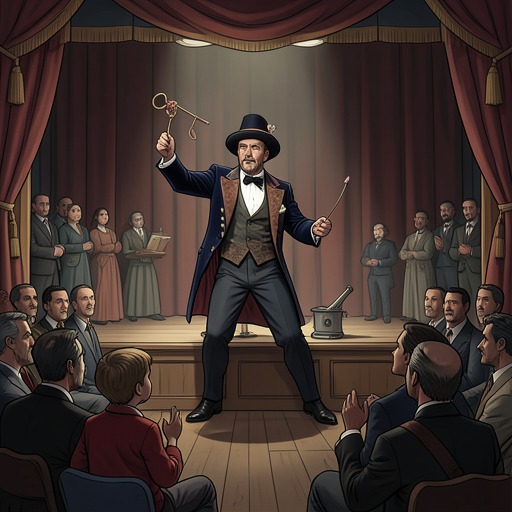
At the Moniuszko Municipal Theatre, Thorn’s entrance turns the audience’s attention into part of the trick. A fashionable, affluent crowd gathers beneath the theatre’s formal architecture, but the defining marvel occurs when Thorn appears before a blue-and-red Chinese pagoda. The spectators cannot identify an entrance: he did not emerge from behind the curtain, step out of the scenery, or move from the darkness. They are certain that he had been standing motionless at centre stage from the moment the curtain rose, watching them, and yet they did not see him. The performance makes collective misperception more astonishing than any visible transformation.
The scene gives theatrical force to Stefania’s interest in the mechanics of illusion. The audience’s certainty does not resolve the puzzle; it sharpens it. Thorn’s method depends on directing attention and exploiting what people assume they have already seen. Much later, amid smoke and fire, Stefania interprets his performances in these terms: he sends in fog and reflects candlelight in dark mirrors. He does not simply lie, she concludes; he creates an illusion, and people see what they want to see. This is not a revelation of the specific mechanism behind his stage appearance, but a change in how Stefania understands the power of the act.
Felix and Thorn’s Contested Story
Thorn’s connection to Felix is presented through an account whose details do not settle into a single reliable version. He says that he had taken in Felix’s mother long before, after finding her in Mandalay, where he had performed for King Mindon Min. He describes her as a slight, remarkably supple performer who repeatedly left the troupe with lovers and returned; on one return, she brought the small Felix, whom the troupe welcomed as its own child. Thorn then interrupts himself with another possibility: perhaps the woman was a young wife from Svaliava whom he had seduced into following him. Stefania hears the shifting story not as harmless reminiscence but as a tactic meant to confuse and weaken her so that he can take the boy.
Thorn’s paper-figure history supplies a broader account of his own beginnings. He tells how Moïse-Avraham Thorn was born in Yaroslav in 1853, the son of a prosperous wool merchant who intended him to inherit the family trade. At ten, after seeing the itinerant magician Simonelli perform on a rough-planked stage at an autumn fair, the boy returned home resolved that he would never be a merchant. By sixteen, the miniature paper figure is already travelling on foot through the Austro-Hungarian Empire with a bundle of coloured scarves, rabbits, pigeons, and ingenious constructions. The tale links Thorn’s adult vocation to an early encounter with spectacle and sets the child’s decision against his father’s plan for him.
That account expands into a miniature panorama of the empire and its varied peoples, landscapes, foods, and territories. It also follows Thorn into Tyrol, where he meets the blonde woman who becomes his future wife and leaves her parents’ home and pedigree horses to travel with him. The paper figures make biography itself resemble an act of performance: Thorn is not only recounting the past but arranging it, scene by scene, on the table before his listeners.
Money, Departure, and the Paper Ship
Thorn’s conflict with Felix becomes explicit when he offers Petro five hundred crowns for the boy. Adèle accepts calmly while Petro protests and asks why Thorn wants Felix so insistently. The exchange makes the boy’s place in the household a matter of both attachment and transaction. It also throws Thorn’s earlier story into a harsher light: whatever his claimed history with Felix, he is prepared to put a price on taking him away.
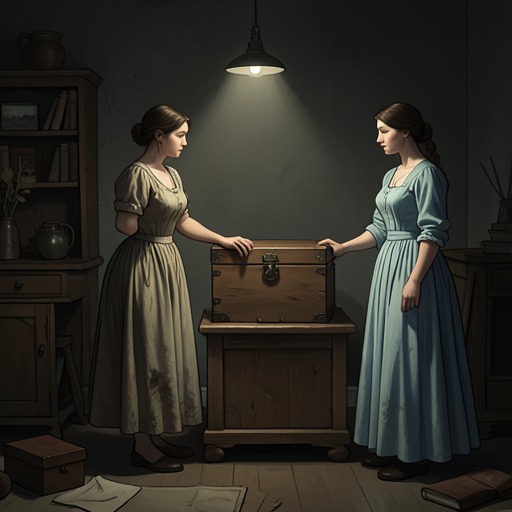
Before leaving, Thorn gives Stefania a paper boat bearing the name S.S. Flintchire and produces a tiny paper Felix from her ear. He says the boy belongs to him, then departs while Petro sees him out and closes the door. The gesture makes the encounter’s competing claims miniature and portable: Felix appears as a figure conjured from Stefania’s body, yet Thorn calls him his own. Adèle, exhausted and massaging her temples, tells Stefania to clear away the paper debris. The scene ends not with a resolution of ownership but with the household left to collect the remains of Thorn’s performance.
Thorn’s later fate remains troublingly open. Stefania believes that he has somehow avoided trial and resumed touring, so his return to the stage follows an accusation without a narrated account of its legal outcome. His survival in public life extends the uncertainty surrounding him: he may be a fraud and a threat, but the evidence does not explain how he evaded judgment or what became of the dispute over Felix.
Legacy as Illusion
The paper boat acquires a future-facing meaning when Stefania imagines herself travelling with Velvele across the ocean aboard the Taormina, departing from Hamburg for a new life. Her vision echoes Thorn’s gift and his prediction of a voyage, but it is Stefania’s imagined departure, not proof that Thorn has arranged or guaranteed her passage. In the same scene, she anticipates pain from her dislocated trunk and its gradual return toward straightness; the hope of travel is joined to a body still marked by injury.
In the novel’s final reflections, Thorn’s artistry becomes a way of naming the gap between appearances and understanding. As the house fills with smoke and its objects melt and disappear, Stefania sees her life as an illusion and recalls how Thorn constructs his shows from fog and reflected candlelight. The magician’s significance therefore exceeds his individual tricks: his performances give the narrative a vocabulary for selective seeing, while the unsettled story of Felix shows how easily performance, persuasion, and claims of ownership can overlap. Thorn makes illusion visible as craft; the more unsettling possibility is that people can inhabit illusions without recognizing them until their familiar world begins to collapse.